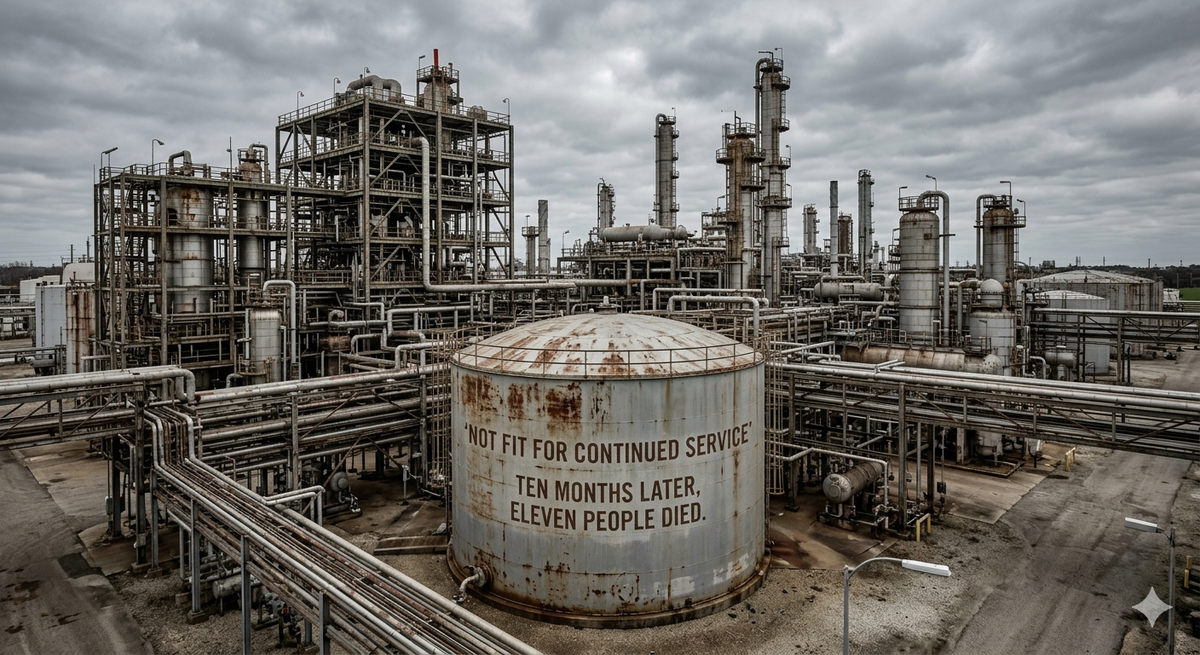
"Not Fit for Continued Service" Ten Months Later, Eleven People Died

Prefer to listen, here is the audio companion for this article.
The Longview Tank Failure and the Lessons Every Supervisor Needs to Hear
Before Anything Else
Eleven workers died at the Nippon Dynawave paper mill in Longview, Washington on May 26, 2026.
Before this article says one word about inspections, systems, or lessons learned, it should say this. Those eleven were people. They were husbands, sons, brothers, coworkers, and friends. They showed up to do their jobs. Their families expected them home.
The Covington brothers, Tyler and Bradley, will not come home. Neither will the eight workers holding a morning meeting in the electrical maintenance shop. Neither will CJ Doran, a newlywed who was building a family. Neither will the two others who ran and did not make it. Firefighters and coworkers ran into the aftermath and were burned trying to help.
The safety world will move quickly to analysis. There is a place for that, and this article is part of it. But it is worth pausing to say plainly that the people at the center of this deserve more than speculation. They deserve honesty. They deserve seriousness. And they deserve to be remembered as people, not as the subject of an incident summary.
With that stated clearly, here is what the record now shows, and what every supervisor, plant manager, and EHS professional should take from it.
What the U.S. Chemical Safety Board Actually Reported
On August 28, 2026, the U.S. Chemical Safety Board, or CSB, released an update on its ongoing investigation into the failure. The update does not yet identify a root cause. What it does document is a paper trail.
In July 2025, an inspection contractor called Applied Technical Services performed an external inspection of the white liquor tank and found "significant thinning" below the minimum safe wall thickness in the lower regions of the tank. The inspection report classified the recommendation as "Priority 1: Not fit for continued service unless corrected," citing a "high likelihood/consequence of failure or critical code/standard deficiency." The report further noted, "Owner should plan to have an internal inspection performed in order to determine the extent of the required repairs. It's likely that the entire shell course should be replaced."
The same contractor performed additional external inspections in October 2025 and February 2026, and both times again identified that large portions of the tank remained thinner than the calculated minimum safe wall thickness. Between the July 2025 inspection and the May 26, 2026 failure, a span of approximately ten months, the CSB found the company performed no internal inspection and no shell repairs. The company did not remove the tank from service, and it did not derate the tank for reduced service pressure.
When the tank failed, it released roughly 900,000 gallons of white liquor, a highly caustic sodium hydroxide and sodium sulfide solution used in the kraft pulping process. It is capable of causing severe chemical burns. The failure came minutes after workers began arriving at 7:00 a.m., and the liquid flowed into the lower floors of surrounding buildings where morning meetings were being held.
CSB Chairperson Steve Owens said the board is "greatly concerned that the tank was not promptly removed from service or properly repaired after the clear findings in the inspection report." The Association of Western Pulp and Paper Workers called the findings "deeply troubling" and said they raise "urgent questions about how technical findings and recommendations concerning the tank were communicated, evaluated and incorporated into decisions about its continued operation."
Those are the facts as the CSB has stated them. This article does not go beyond them.
Why This Matters to Every Supervisor, Not Just Pulp and Paper
Most people reading this do not run a pulp mill. They will never see a white liquor tank. That does not matter. The transferable lesson has almost nothing to do with pulp and paper, and almost everything to do with what happens between the moment a warning is written down and the moment somebody acts on it.
In every operation I have ever worked in, and every operation you have worked in, warnings arrive constantly. Some are urgent. Some are noise. Some are inconvenient. Some are expensive to fix. The essential job of a supervisor, and of every leader in the chain, is to make sure the urgent ones do not quietly become the ignored ones.
At Longview, a qualified third-party inspector wrote the words "not fit for continued service" on paper. Then they wrote it again. Then they wrote it a third time. Over the course of ten months, the distance between that piece of paper and a decision to act became too long. Most facilities, most days, have a gap like that. Most of the time, nothing catastrophic happens in the gap. Sometimes it does.
Inaction Is a Decision
This is the part that has to be said out loud, because I think it is the piece most people miss.
If you are a supervisor and an inspection report lands on your desk that says Priority 1, not fit for continued service, your obligation is not to determine whether it is convenient to act. It is not to weigh the finding against the production schedule. It is not to send it upstairs and wait to see if anyone follows up.
Your obligation is to act, escalate, and document, in whatever order makes the risk go down the fastest.
If the equipment cannot be removed from service without production consequences, that is a decision that must be made by somebody with the authority to accept that risk in writing, with the full technical picture in front of them. It is not a decision that gets made by inaction. It is not a decision that gets made by the calendar page turning.
When you receive a warning and do nothing, you have decided. You have decided the warning was wrong, or overstated, or not urgent, or somebody else's problem. And if you did not have the technical basis to make that decision, you have decided to gamble on somebody else's life without their consent.
Every worker who arrived at Longview at 7:00 a.m. on May 26, 2026 was, in a way, betting their life on decisions made in offices they had never seen, about a tank they had probably never inspected, by people they had probably never met. That is the position every worker in every industrial facility is in, every day. The people making the decisions in the offices owe them the seriousness that bet deserves.
The Consequences Are Not Just Corporate
There is another part of this that supervisors and leaders need to hear clearly, because I do not think it gets talked about enough in the field.
When a Priority 1 finding sits unaddressed and workers die, the consequences are not always confined to the corporation. Depending on the facts, they can reach individual supervisors, managers, and executives personally.
Under federal law, willful violations of OSHA standards that result in a worker's death can trigger criminal prosecution of individuals, not just fines against the company. State workplace safety agencies in many jurisdictions have their own criminal enforcement authority as well. Beyond that, prosecutors have used general criminal statutes, including negligent homicide, reckless endangerment, and manslaughter, in cases where they believe a decision-maker knew of a serious hazard and failed to act. Civil liability in wrongful-death lawsuits does not stop at the corporate wall either, and disciplinary actions inside a company, from termination to permanent loss of professional standing in the industry, are almost always on the table when an event of this scale occurs.
I am not a lawyer, and this article is not legal advice. I am also not saying any of these outcomes will happen in the Longview case. What I am saying is that if you are a supervisor, a plant manager, an engineer, or an executive, and a document lands on your desk that says a piece of equipment is not fit for continued service, the personal exposure of doing nothing is real. It is not a theoretical corporate risk that lives on a spreadsheet in the legal department. It can follow the individuals who had the authority to act and did not.
I have known good people in this industry who lost their careers over a decision they thought was defensible at the time. I have also known good people who kept their careers because when the warning landed on their desk, they stopped the equipment, took the production hit, absorbed the pressure from above, and were later proven right. The second group is who I try to write for.
The Questions Every Leader Should Ask Tomorrow Morning
You do not need a formal audit to start. Ask these questions in your next supervisor's meeting or plant walk, and you will learn more than most root-cause analyses will teach you.
1. When an inspection report is delivered to this facility, who reads it, and how do we prove that person read it?
Not who is supposed to read it. Who actually does. In what system. With what evidence. If the answer is that it goes to maintenance, or somebody in engineering, or "it gets handled," you have a gap.
2. When a finding is classified as Priority 1, or Critical, or Category A, or whatever your nomenclature is, what is the maximum allowable time between the finding and a documented action decision?
Not the fix. The decision. Repair, replace, derate, remove from service, or accept the risk in writing. If your answer is "it depends" or "we handle those quickly," you do not have a policy. You have a hope.
3. Who has the authority, and the obligation, to remove an asset from service?
If the only path to shutdown runs through the person whose production number takes the hit, you have built a conflict of interest into your safety system. Somebody in the chain, ideally not the person accountable for uptime, must be empowered and expected to say stop.
4. When repeat inspections identify the same unresolved finding, what happens?
At Longview, the same contractor documented the same wall-thinning issue across three inspections over roughly eight months. That pattern, the same finding recurring, is the loudest possible signal that the system for closing findings is not working. What does your facility do when a finding shows up on inspection number two, and then again on inspection number three? If the answer is that it goes back into the queue, the queue is your problem.
5. Do you know the difference between "the work order is closed" and "the hazard is corrected"?
I wrote about this in a previous article called "Closed in the System Is Not Fixed in the Field." An entry in a CMMS is not a repair. A repair is a repair. A follow-up verification, done in the field by somebody other than the person who did the work, is what turns a closed work order into a closed loop.
6. If a Priority 1 finding sat on your desk for ten months, would anyone notice?
If your management system does not automatically escalate un-actioned high-severity findings up the chain, to the plant manager, to the general manager, to the corporate safety leader, then any single supervisor with a full plate can accidentally become the last line of defense. That is unfair to them, and it is unsafe for everyone downstream.
What EHS Professionals Can Do This Week
The final CSB report is not out yet. There will be more facts. There may be causes and contributing factors that reshape how we understand what happened. This article does not pretend to know what those will be.
But we do not have to wait for the final report to act on what is already public. Right now, this week, every EHS professional reading this can do the following.
Pull your last twelve months of third-party inspection reports and read them yourself. Look for Priority 1 or equivalent findings, and for each one, verify in the field, not in the system, that the corrective action was actually completed.
Review your escalation protocol for high-severity findings. If findings can sit longer than 30 days without being surfaced to plant leadership, fix that this month.
Interview one supervisor. Ask them what they would do, right now, today, if they received an inspection report that said "not fit for continued service." Listen to the answer. If it is vague, that is your work.
Look at your repeat findings. Anywhere the same problem is showing up across multiple inspections is a red flag that your closure process is not closing.
Talk to your inspection contractors. Ask them if there are findings they have flagged multiple times at your site. Their answer may surprise you.
None of these actions require a budget approval. None of them require a corporate initiative. They require an hour, a walk, and a willingness to look at the answer even if the answer is uncomfortable.
The Last Word
Eleven people died in Longview because, as far as the record now shows, a warning was written down and not acted on. Whatever else emerges from the investigation, that fact is already established.
The right response is not outrage. Outrage does not save the next eleven. The right response is the quiet, disciplined, unglamorous work of making sure that in your facility, on your watch, warnings do not go unread, findings do not go unactioned, and the gap between paper and reality does not become the gap between life and death.
That is what these workers deserve from all of us. That is the only tribute worth writing.
Source: U.S. Chemical Safety Board update released August 28, 2026, reported by Claire Rush of The Associated Press via The Seattle Times. This article is based solely on the CSB's public findings and statements to date. It does not speculate on cause, intent, or liability, all of which remain the subject of ongoing federal and state investigations.