Closed in the System Is Not Fixed in the Field

Prefer to listen, here is the audio companion for this article.
One of the more common mistakes organizations make in EHS is confusing closing something in a system with actually fixing it. An issue gets identified, a corrective action gets assigned, a due date gets added, and eventually somebody updates the software and marks the item complete. From a tracking standpoint, that can look like progress. The dashboard improves, the open-item count goes down, and the meeting report looks cleaner than it did the week before.
The problem is that none of that automatically means the underlying issue was truly fixed.
I have seen plenty of corrective actions get closed in the system while the real condition in the field stayed largely the same. The hazard was still there, people were still unclear on the expectation, or the same weak control was still one bad day away from failing again. In those cases, the organization did not actually solve the problem. It just documented movement around it.
That is part of what makes this issue so important. Once something is marked complete, people tend to relax. Leaders move on to the next concern. The metric looks better. The pressure comes off. But if the field did not change in a meaningful way, then the risk may not have changed much either.
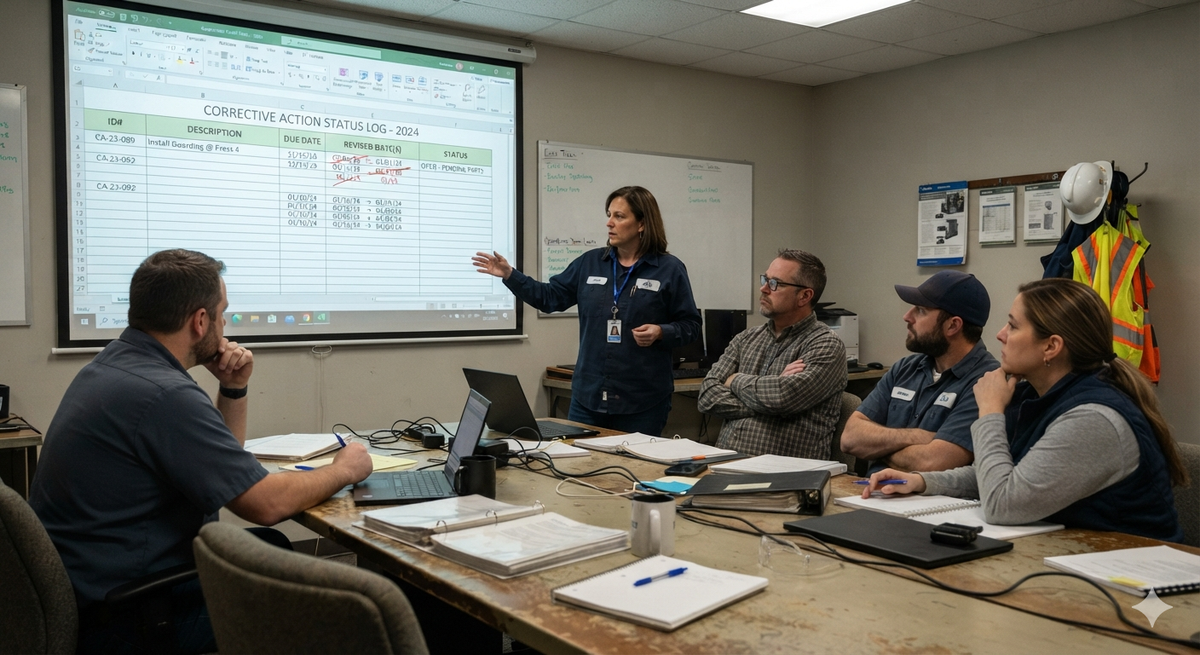
I can remember weekly CI, continuous improvement, meetings where the running joke became "cross out the date and add a new one." The same actions stayed on the board week after week, and after a while everybody knew the routine. Sometimes the items were not being handled with any urgency. Other times the actions were so weak or so disconnected from the real problem that nobody felt much conviction about them in the first place. Either way, the meeting kept moving, the dates kept changing, and the real issue kept hanging around.
Closure can create the illusion of control
There is nothing wrong with tracking corrective actions. Organizations should track them. Ownership matters. Due dates matter. Follow-through matters. Without some discipline around action management, problems drift, accountability gets fuzzy, and important issues stay open indefinitely.
Where things start to go wrong is when the system becomes more focused on whether the action was completed than on whether it was effective.
That is when corrective action management starts to turn into an administrative exercise instead of a risk-reduction process. The question becomes, "Did we do something?" when it really should be, "Did anything actually get better?" Those are not the same question, and they do not produce the same result.
If a procedure was updated, did anyone verify that the people doing the work understood the change? If a toolbox talk was delivered, did the job look any different in the field afterward? If equipment was repaired, did anyone address why it had been allowed to get into that condition in the first place? If an investigation produced recommendations, did those recommendations actually reduce the chance of the issue coming back, or did they just satisfy the need to close out the report?
Those are the questions that tell you whether the corrective action actually mattered.
A completed action is not always a meaningful action
This shows up in ways that are usually very familiar. A housekeeping problem gets corrected before an audit or leadership walk, but two weeks later it starts creeping back because nobody addressed the expectation or ownership behind it. A damaged guard gets replaced, but no one asks why the equipment kept being operated in that state. A team gets reminded about a requirement, but the same confusion shows up again the next time the job gets busy. An incident review gets wrapped up, and a few months later the same weak signal appears somewhere else under slightly different circumstances.
Technically, those actions may all count as completed. But completed does not always mean effective.
That distinction matters because good corrective action is not just about taking action for the sake of activity. It is about reducing the chance that the same problem will come back. If the response does not strengthen the work, clarify the expectation, improve the control, or change the behavior that allowed the issue to happen, then the organization may be giving itself credit for progress it has not really earned.
Metrics can quietly drive the wrong behavior
I understand why leaders want open items closed. Nobody wants a bloated backlog. Nobody wants old actions sitting unresolved for months. But when the dominant pressure in the system becomes "get it closed," people respond to that pressure in very predictable ways.
They look for the fastest acceptable fix. They choose easy actions over meaningful ones. They document activity instead of proving effectiveness. They close the item when the form is complete instead of when the work is actually better.
That does not always happen because people are careless. A lot of times it happens because the system has taught them what success looks like. If closure rate gets more attention than control quality, people will naturally optimize for closure rate. If the monthly report rewards lower open counts more than stronger verification, the report itself starts shaping the behavior.
That is when organizations end up with neat dashboards and weak assurance at the same time.
The field is where corrective actions get judged
In my experience, the real test of a corrective action does not happen in the tracking software. It happens after the meeting is over, after the item is assigned, and after somebody decides it is complete. That is when somebody needs to go back and look at the work itself.
Go see whether the condition is actually different. Go talk to the people doing the job. Go find out whether the supervisor is reinforcing the change. Go ask whether the crew understands what was supposed to improve and why. Go verify whether the fix is practical enough to hold up once normal production pressure returns.
That is where corrective actions stop being theoretical.
If the same confusion is still there, if the same exposure is still there, or if the same drift is still present in the work, then the issue may be closed in the system, but it is not closed where it counts. And if it is not closed where it counts, the organization is still carrying more risk than the dashboard suggests.
Shallow corrective actions usually come back
Some corrective actions fail because they were never aimed at the real problem in the first place. "Retrain the employee." "Review the procedure." "Remind the team." "Discuss it in the next meeting." There are times when those steps may be appropriate as part of a broader response, but too often they become default actions because they are quick, familiar, and easy to document.
The problem is that they often sit at the surface.
If the real issue was weak supervision, poor planning, bad equipment condition, unclear ownership, conflicting production pressure, or a control that does not hold up well in the field, then a reminder by itself is not much of a fix. It may create the appearance of response, but it may do very little to change the conditions that made the problem likely in the first place.
That is one reason repeat issues deserve so much attention. Recurrence often tells you that the original action treated the symptom without dealing with the condition behind it.
Strong organizations verify effectiveness, not just completion
The better organizations understand this. They do not stop at "done." They revisit significant actions. They verify that the fix held up. They check whether the change actually showed up in the field. They look for recurrence, not just closure. And when the evidence suggests the action was closed too early, they are willing to say so and reopen the conversation.
That is not a sign of weakness. It is a sign of honesty.
What is dangerous is pretending an issue is solved because the spreadsheet looks better. Corrective action systems are supposed to help organizations reduce risk, not give them a more polished way to overestimate their level of control.
The takeaway
Corrective actions matter, and so does tracking them. But administrative completion should not be mistaken for actual resolution. A corrective action should not be considered successful simply because the software says it is closed. It should be considered successful when the work is better, the controls are stronger, the expectation is clearer, or the likelihood of recurrence is lower.
If the field did not change, then the risk probably did not change much either.
And if the risk did not change, calling the issue closed may be one of the more expensive forms of optimism an organization can practice.
Practical Takeaway
- Do not accept corrective action closure without some form of effectiveness check.
- Verify meaningful actions in the field, not just in the tracking system.
- Watch for repeat issues that suggest the original action was too shallow.
- Be cautious of default fixes like "retrain" or "remind the team" when the underlying problem is structural.
- Measure success by reduced recurrence and better execution, not just by lower open-item counts.
---
Bryan Barker is an EHS professional with experience across construction, mining, general industry, and environmental leadership. True North EHS provides practical safety insight for real-world operations.