What You Walk Past Becomes the Standard
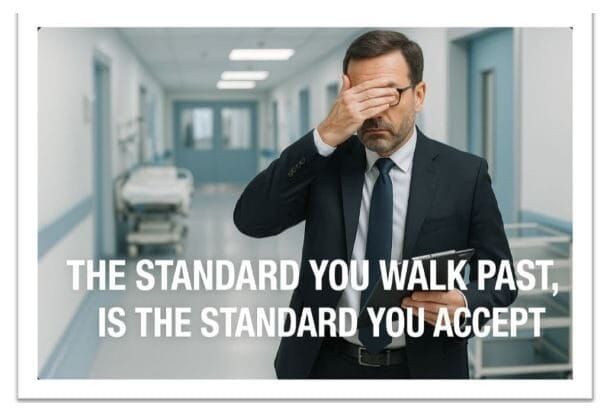
If you see something and say nothing, you just helped set a new standard. Courageous safety leadership means speaking up every time — because what leaders tolerate becomes what the organization accepts.

Prefer to listen? Here's the podcast-style audio companion for this article.
Leaders set standards in more ways than most people realize.
They do it through policies, procedures, training, and expectations. But they also set standards through what they ignore, what they walk past, and what they allow to continue without correction.
That is one of the simplest and most important realities in safety leadership.
If you see something and say nothing, silence becomes permission. And permission becomes the new standard.
Standards are not defined by what is written
Most organizations have no shortage of written expectations. They have policies, rules, programs, and values posted on walls and repeated in meetings. But the real standard inside an operation is not defined by what is written down. It is defined by what is consistently tolerated in real time.
If a supervisor walks by a blocked exit and says nothing, that tells the workforce something. If a leader sees poor housekeeping, missing PPE, rushed shortcuts, or unsafe conditions and chooses not to address them, that sends a louder message than any written policy ever will.
People pay close attention to what leadership actually enforces. They learn very quickly whether expectations are real, optional, or just words on paper.
What you tolerate becomes normal
Unsafe conditions rarely become normal all at once. It usually happens one small moment at a time.
A shortcut gets ignored. A condition goes uncorrected. A behavior gets excused because everyone is busy. Over time, those small acts of tolerance create a new operating standard, one that may be very different from the one leadership thinks exists.
That is how organizations drift. Not always through dramatic failures, but through repeated small decisions to let things slide.
Once that drift starts, it becomes harder to correct because people no longer see the issue as unusual. It becomes part of how the work gets done.
Courageous safety leadership is visible
Strong safety leadership is not just about saying the right things in meetings. It is about acting in the moment.
Courageous leaders correct what needs to be corrected, even when it is inconvenient. They ask questions when something feels off. They step in when a condition or behavior does not meet the standard. And they do it consistently enough that the workforce understands the expectation is real.
This does not require drama. It requires clarity, consistency, and the willingness to address issues before they become culture.
The real message workers hear
Every time leadership walks past something unacceptable without responding, a message is sent.
The message is not, “We are busy.” It is not, “We will get to it later.” The message workers hear is much simpler: this must be acceptable here.
That is why small moments matter so much. They shape what people believe about the organization’s real priorities.
And once employees believe a standard is flexible, the safety culture weakens fast.
The takeaway
What leaders tolerate becomes what the organization accepts. What the organization accepts becomes how the work gets done. And how the work gets done ultimately determines whether people are protected or exposed.
If you want a stronger culture, do not just improve the written standard. Pay attention to the lived standard.
Because what you walk past becomes the standard.
Bryan Barker is an EHS professional with experience across construction, mining, general industry, global manufacturing, distribution, retail, data centers, and energy. True North EHS provides practical safety insight for real-world operations.