The True North EHS, Issue #4


Prefer to listen, here is the audio companion for this article.
True North EHS, Issue #4
The Story Your Safety Program Is Actually Telling
Every organization has a safety narrative.
The question is whether that narrative is being shaped by leadership statements, safety posters, and company messaging, or by what actually happens in the field every day.
I heard a saying recently that stuck with me, the narrative is only as good as what we can deliver on. In other words, if we say what we are going to do, we need to do what we say.
That applies directly to safety leadership.
It is easy to say safety is a priority. It is easy to talk about culture, accountability, and expectations. But employees are not forming their opinions based on the wording in a presentation or the slogan on the wall. They are forming those opinions based on what gets reinforced, what gets corrected, and what gets ignored.
That is the story your safety program is actually telling.
If leadership says PPE matters, but employees routinely wear it incorrectly without correction, that tells a story.
If the organization says safe work practices are non negotiable, but production pressure consistently wins, that tells a story.
If accountability only shows up after something goes wrong, that tells a story too.
The truth is, safety culture is not built by intention alone. It is built by delivery.
That is why accountability matters so much. Accountability is not just about holding people responsible when they make a mistake. It is also about being honest enough to own the outcome. If the message is not landing, if the standard is not being followed, if the expectation is not clear in practice, leaders have to own that too.
And beyond accountability, strong safety cultures require challenge.
We have to be willing to challenge ourselves, our teams, and sometimes even our habits. Are we reinforcing the standard we claim to believe in, are we correcting small things before they become normal, are we willing to address the gap between what we say and what people actually experience?
Because if we do not challenge those gaps ourselves, eventually an incident, a citation, or a loss will do it for us.
In the end, the story your safety program tells is not based on your best intentions. It is based on what your people see, hear, and experience every day.
So the question is simple.
What story is your safety program telling, and does your daily delivery support it?
Quick Regulatory Hits
OSHA Hazard Communication deadline extended
OSHA extended the compliance date for certain requirements in its updated Hazard Communication Standard. Manufacturers, importers, and distributors now have until May 19, 2026, for the first major compliance deadline, with later employer obligations also pushed out. If HazCom updates are still sitting on the back burner, now is the time to move them forward.
MSHA silica rule remains on hold
MSHA’s newer silica rule remains delayed while litigation and rule reconsideration continue. In the meantime, the agency is continuing to enforce existing standards. A pause in enforcement of the new rule should not become a pause in exposure control.
EPA PFAS reporting timeline pushed back
EPA extended the reporting period tied to PFAS reporting requirements under TSCA, the Toxic Substances Control Act. PFAS refers to per and polyfluoroalkyl substances, a broad group of man made chemicals that have drawn growing regulatory attention. The extension gives affected companies more time, but it does not remove the need to understand whether reporting obligations apply.
PPE Spotlight, Safety Helmets Are an Upgrade, But Only If the Standard Is Real
One of the better PPE improvements I have seen in recent years is the move from traditional hard hats to modern safety helmets with chin straps.
The newer helmet designs offer meaningful advantages. They provide better overall head protection, improved retention, better comfort, and in many cases better visibility. The bright yellow helmets we are using also make workers easier to spot in the field, which is another practical safety benefit.
I also like some of the newer climbing style helmet designs now being used in industry. A good example is the Petzl professional helmet line, which reflects how head protection continues to improve in comfort, fit, and overall usability. When PPE is more comfortable and better designed, workers are more likely to wear it correctly and consistently.
That said, better equipment alone does not create a better standard.
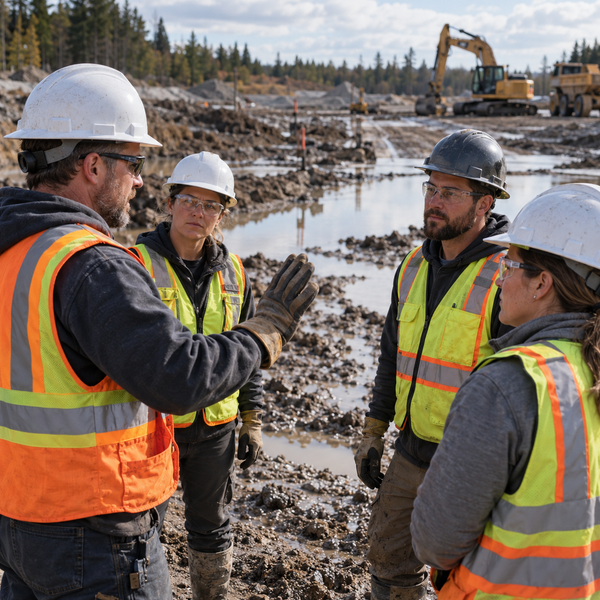
If employees are wearing the helmet, but leaving the chin strap undone, the protection is not what it should be. If that shows up in the field, or even in internal photos without correction, the message becomes clear, the standard is optional.
That is the bigger lesson.
A stronger helmet is a real improvement in PPE, and it is worth recognizing. But like every other part of a safety program, its value depends on whether the expectation is consistently reinforced.
The equipment matters, the standard matters more.
From the Site
Why Storytelling Still Matters in Safety
Safety professionals spend a lot of time focused on data, procedures, and compliance, and those things matter. But if we want people to truly remember the message and carry it with them, we have to do more than deliver information. We have to make it personal.
If you have not read it yet, check out my recent article on the power of storytelling in EHS.
Dad Joke of the Issue
I used to hate facial hair, but then it grew on me.