The Gap Between Environmental Compliance and Environmental Performance

Prefer to listen, here is the audio companion for this article.
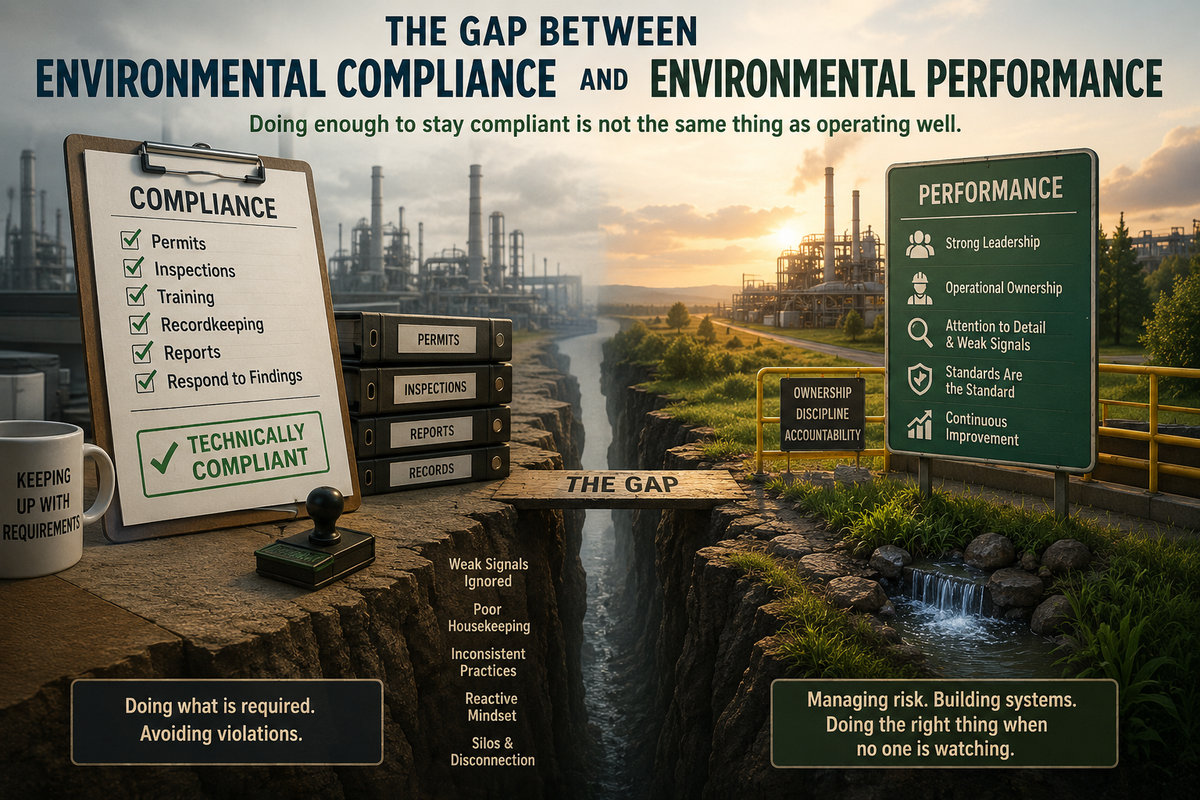
Why doing enough to stay compliant is not the same thing as operating well
Over the course of my career, I’ve seen a lot of organizations put real effort into environmental compliance. They had permits in place. They completed inspections. They kept records. They submitted reports. They responded to findings. On paper, they were doing what they were supposed to do.
And yet, in many of those same organizations, I still saw environmental risk sitting just below the surface.
That’s because environmental compliance and environmental performance are not the same thing.
Compliance matters. It always will. Permits matter. Inspections matter. Documentation matters. But in my experience, a company can be technically compliant and still be operating with weak controls, poor discipline, and the kind of day-to-day inconsistency that eventually creates bigger problems.
Where the gap begins
I’ve seen operations where people were focused on staying within the lines of the permit, but not nearly focused enough on the conditions that could put them outside those lines.
I’ve seen environmental responsibilities treated like a support function instead of an operational one.
I’ve seen environmental issues handed off to one person or one department, as if performance could be separated from the way the rest of the business actually runs.
That mindset is where the gap begins.
Real environmental performance is not just about avoiding violations. It is about how well an operation manages risk, maintains discipline, responds to changing conditions, and builds systems that hold up even when no one is watching.
Compliance can hide weak performance
In my experience, the organizations that struggle the most are usually not the ones that openly do not care. Most of them do care. Most of them want to do the right thing.
The problem is that they define success too narrowly.
If there was no notice of violation, no spill, no enforcement letter, and no major event, they assume things are working.
Sometimes they are.
But sometimes what looks like success is really just a lack of visible failure.
That is a dangerous place to operate.
Weak signals matter more than people think
I’ve seen environmental programs that looked stable until a stormwater issue exposed weak housekeeping.
I’ve seen waste management problems that were not really waste management problems at all, they were operational discipline problems.
I’ve seen environmental findings that traced back to poor maintenance, weak ownership, bad communication, or supervisors treating standards like suggestions instead of expectations.
That is why I’ve come to believe that environmental performance is shaped far more by daily operating culture than by policy language alone.
What strong environmental performance looks like
The organizations that perform well environmentally usually do a few things differently.
1. They do not isolate environmental responsibility from operations
They understand that environmental performance is not owned only by the environmental professional.
It is influenced by supervisors, maintenance teams, operators, planners, and leaders at every level.
The environmental person may guide the system, but the operation has to live it.
2. They pay attention to weak signals
They do not wait for a violation to tell them something is wrong.
They notice recurring housekeeping issues, inconsistent inspections, delayed corrective actions, poor container management, bad labeling practices, erosion concerns, repeated near misses, and all the other little things that usually show up before the larger problem does.
In my experience, environmental failures rarely appear out of nowhere. They usually build slowly while people normalize conditions they should have addressed earlier.
3. They treat standards like standards
Not recommendations. Not good ideas. Not things to tighten up only when an audit is coming.
The strongest environmental programs I’ve seen are the ones where expectations are clear, reinforced, and backed up in the field.
People know what good looks like, and leadership is willing to hold the line when performance slips.
The leadership piece gets overlooked
That part matters more than many people realize.
I’ve seen organizations spend a lot of energy rewriting procedures when the real issue was not the procedure.
The real issue was that people were already walking past the standard every day, and nobody was stopping it.
The same thing happens in safety, and it happens in environmental performance too.
Once the standard becomes optional, the system starts weakening whether anyone says it out loud or not.
Environmental performance is a leadership test
Another thing I’ve learned is that environmental performance is often a leadership test disguised as a compliance issue.
It tests whether leaders pay attention to details that do not always create immediate pain.
It tests whether supervisors reinforce expectations consistently.
It tests whether maintenance and operations are aligned.
It tests whether corrective actions actually get completed and stay effective.
And it tests whether the organization is willing to act on small warning signs before they become bigger events.
That is a very different standard than simply asking whether the permit is current or the report was submitted on time.
Those things matter, but they are not enough by themselves.
The real question
If I walk into an operation and hear that environmental performance is important, but then see poor housekeeping, sloppy storage practices, recurring leaks, weak follow-up, or inconsistent field discipline, I already know the program is more fragile than people think.
The paperwork may still be in order.
The exposure is still there.
That is the gap.
The gap between environmental compliance and environmental performance is the distance between what the system requires and how well the operation actually functions.
Closing the gap
Closing that gap takes more than technical knowledge.
It takes leadership.
It takes operational ownership.
It takes discipline in the field.
It takes stronger follow-through.
And in my experience, it takes a willingness to stop treating environmental performance like a separate lane and start treating it as part of how the business performs overall.
That is when things begin to change.
Because the goal should not be to do just enough to stay out of trouble.
The goal should be to build an operation that is disciplined enough, aware enough, and well-led enough that strong environmental performance becomes part of how work gets done.
That is a much higher standard.
It is also a much better one.