The Gap Between Compliance and Real Safety Performance
Why compliance is only the floor, and what real safety performance requires from leaders, systems, and operational discipline.

Prefer to listen? Here's the podcast-style audio companion for this article.
Compliance matters.
It creates the baseline for responsible operations. It establishes minimum expectations, defines non-negotiables, and provides a framework for controlling risk. Every serious EHS professional understands that.
But compliance alone does not guarantee strong safety performance.
That is where many organizations get stuck.
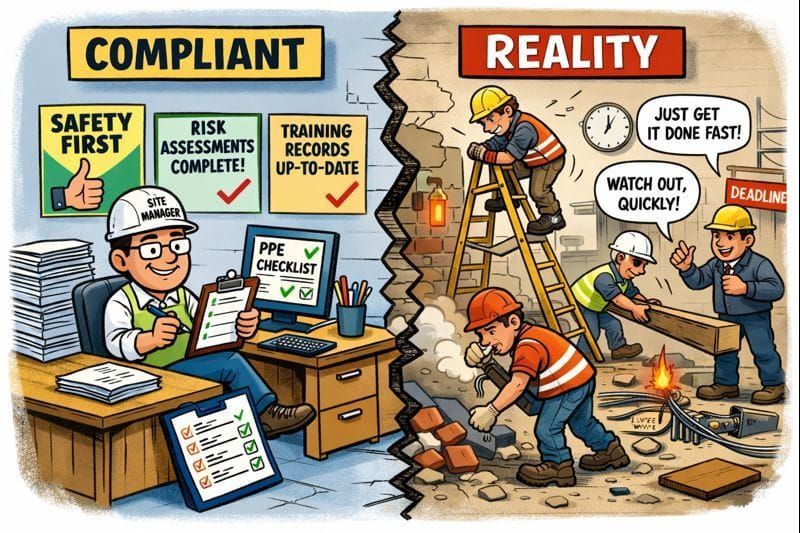
A company can have policies, training records, inspection checklists, written procedures, and acceptable documentation—and still operate with weak hazard recognition, inconsistent leadership engagement, poor follow-through, and preventable exposure to serious risk. On paper, the system may appear sound. In practice, the operation may be far less stable than leadership realizes.
That gap between compliance and real safety performance is one of the most important realities in EHS.
Too often, organizations treat compliance as the finish line. If the required forms are complete, the training is documented, the audit scores look strong, and the policies are updated, they assume the system is working. But real safety performance is not measured by how complete the paperwork looks. It is measured by how well risk is understood, managed, communicated, and reduced in the real world.
Compliance is the floor. It is not the ceiling.
Why compliance alone falls short
Compliance creates structure and accountability. It forces organizations to address hazards, responsibilities, training, reporting, and controls. That matters. But regulations and internal requirements are not designed to capture every weakness in execution, leadership behavior, decision-making, or operational discipline.
An organization can be technically compliant and still have:
- supervisors who do not consistently address unsafe behaviors
- corrective actions that are documented but not truly resolved
- incident investigations that identify symptoms instead of root causes
- training that is completed for recordkeeping rather than retention
- frontline employees who do not trust the reporting process
- leaders who speak about safety but manage production more aggressively than risk
In those environments, compliance may exist, but real safety performance remains fragile.
That fragility often stays hidden until something significant happens: a serious injury, a high-potential near miss, a pattern of repeat incidents, or a regulatory event that exposes broader operational weakness. When that happens, organizations are often surprised because they believed their systems were stronger than they actually were.
What real safety performance looks like
Real safety performance is visible in day-to-day execution.
It looks like leaders who are present, engaged, and credible. It looks like supervisors who do more than enforce rules—they coach, observe, correct, and reinforce expectations in real time. It looks like employees who understand hazards, raise concerns, and believe that reporting leads to action.
It also shows up in the quality of the system itself.
Strong safety performance means hazards are identified early, investigations go beyond surface causes, and corrective actions are closed in ways that actually reduce recurrence. It means training is relevant and usable. It means the organization is not just collecting metrics, but using them to make better decisions. It means safety expectations are aligned with operational reality, not separated from it.
In strong environments, safety is not just a compliance program. It is part of how the work is led.
Where organizations lose ground
One of the most common failures in EHS is confusing activity with effectiveness.
A company may be very active—conducting audits, holding meetings, assigning training, producing reports—and still not be improving where it matters most. That happens when the system is focused more on completion than impact.
A few common warning signs include:
Overreliance on lagging indicators
Injury rates, recordables, and incident counts matter, but they are backward-looking. They tell you what happened, not necessarily what is developing. Organizations that rely too heavily on lagging indicators often miss weak controls, inconsistent execution, and growing exposure until after something occurs.
Check-the-box training
Training delivered only to satisfy a requirement rarely changes behavior. If employees attend training without understanding how it connects to the work, the organization may remain compliant while risk remains unchanged.
Weak corrective action discipline
Corrective actions are one of the clearest indicators of whether a system is serious. If issues are repeatedly identified but not meaningfully resolved, or if closure means paperwork completion rather than true risk reduction, performance will stall.
Poor supervisor ownership
No safety program performs well if frontline leaders treat safety as someone else’s function. EHS can support, coach, and provide systems, but daily execution lives with operational leadership.
Audit success mistaken for operational strength
Audits have value, but a successful audit does not automatically mean the operation is healthy. Audits can confirm the presence of systems. They do not always reveal whether those systems are deeply understood, consistently applied, or trusted by the workforce.
What closes the gap
Closing the gap between compliance and real safety performance requires organizations to move from documentation-driven thinking to execution-driven thinking.
That starts with leadership.
Leaders set the tone by making it clear that safety is not just a reporting function or a monthly metric. It is an operating expectation. That means asking better questions, paying attention to conditions in the field, following through on issues, and holding the organization accountable for more than appearances.
It also requires better systems.
Investigations must lead to learning, not just closure. Training must connect directly to task risk. Metrics must help identify weakness before events occur. Corrective actions must be practical, timely, and sustainable. Safety processes must be usable in the real environment—not just technically correct in a written procedure.
Most importantly, organizations need consistency. Employees watch closely for the gap between what leadership says and what leadership tolerates. If the message is that safety comes first, but daily decisions reward speed, output, or convenience over control, the real culture becomes obvious very quickly.
Strong safety performance is built when policy, leadership behavior, operational expectations, and follow-through all point in the same direction.
The real standard
The goal is not to choose between compliance and performance. Strong organizations need both.
Compliance remains essential. It provides the framework, establishes responsibilities, and reduces legal and regulatory exposure. But if an organization wants real safety performance, it has to build beyond that foundation.
That means developing a system that works under pressure, not just on paper.
It means creating conditions where hazard recognition improves, trust increases, leaders engage, and operational decisions consistently support risk reduction. It means treating compliance as the beginning of the conversation—not the end of it.
Because the organizations that perform best in safety are rarely the ones asking only, *Are we compliant?*
They are the ones asking the harder and more useful question:
Are we actually getting safer?