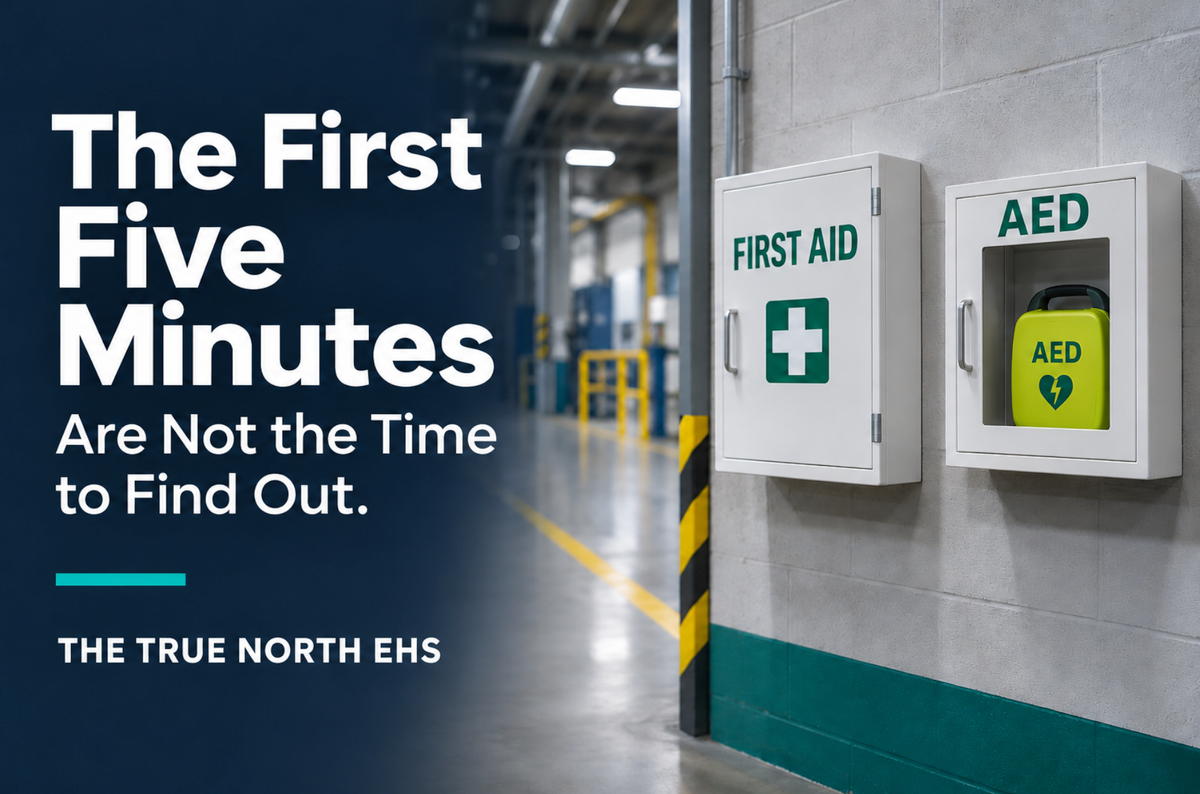
The First Five Minutes Are Not the Time to Find Out

Prefer to listen? Here is the audio companion for this article.
“Where’s the first aid box?”
That question has stayed with me for years. Not because someone asked it during an actual emergency, but because I was glad they asked it during a drill.
At a facility I worked with years ago, we had on-site first responders trained in basic first aid, AED use, trauma response, and how to use the items in our first aid boxes. We held drills regularly.
We had trained people. We had equipment. But this particular drill showed us that we still had work to do.
We had the training. Now we needed to use it.
I asked one of our security guards if he would help with a drill by pretending to have a heart attack. He agreed. We put the call out for our first responders to report to the location, and I videotaped the exercise.
When they arrived, they were kind of wandering around him, unsure of what to do.
I asked, “What are you going to do?”
One of the responders said, “I don’t know. Maybe grab a first aid box.”
I encouraged him. “Good job.”
Then he asked, “Where’s the first aid box?”
That got my attention.
These were the people we were counting on to respond, and they were unsure where to find the supplies. The drill also showed uncertainty about what to do when they got there.
To be clear, getting a first aid box is not, by itself, a response to a suspected heart attack. Calling emergency medical services and responding within their training were essential. Finding equipment was one part of a larger gap we needed to address.
But I was glad we found it. This was a drill. We could let them work through the situation, learn from it, and make improvements without someone actually needing help.
We gave them a reason to know the equipment
After that drill, I had our first responders go through the facility every month to inspect and audit the first aid boxes.
We standardized the boxes and made sure they contained the supplies we needed. Those monthly rounds also helped the responders learn exactly where the first aid boxes and AEDs were located.
They were no longer just aware that we had emergency equipment somewhere in the building. They were going to those locations, checking the supplies, and becoming familiar with what was available.
That increased their awareness and gave them more confidence in responding to different situations.
It did not replace training or drills. It connected that training to their own workplace.
Knowing how to use an AED matters. Knowing where it is when you need it matters, too.
A drill is an opportunity, not a performance
I do not look at that exercise as a failure. I look at it as an opportunity we were fortunate enough to have.
The responders showed us where they needed more preparation. Our responsibility was to take what we learned and do something with it.
For me, that is the value of practicing. Not proving that everyone can get through an exercise without a mistake, but finding the uncertainty while we still have time to address it.
If you have trained responders at your facility, do they know where the equipment is? Have they practiced responding in the areas where your employees actually work?
Those are worth finding out before the call is real.
I am still glad that security guard was only pretending. I am glad our responders had the chance to ask questions, work through the situation, and build their confidence.
“Where’s the first aid box?” was a valuable question during a drill. I would not want someone’s life depending on how long it took us to answer it.